
FAQ schema is one of the most underused tools in travel SEO. I have implemented it across 40+ tourism websites, and when done right, it consistently drives featured snippet wins and increases click-through rates by 15-30%. The problem is that most travel marketers either skip it entirely or implement it so poorly that Google ignores it.
This guide covers everything you need to know about FAQ schema for travel websites: which questions actually win snippets, how to implement the markup correctly, and the formatting tricks that separate winners from the rest.
What is FAQ Schema and Why It Matters for Travel?
FAQ schema is structured data markup that tells search engines which questions and answers appear on your page. When Google recognizes this markup, it can display your FAQs directly in search results as rich snippets or use them to answer voice queries.
For travel websites specifically, FAQ schema matters because travelers ask a lot of questions before booking. What is the best time to visit Costa Rica? Do I need a visa for Thailand? How much does a safari cost? These information-seeking queries represent massive traffic opportunities.
Questions that drive conversions
When I built CostaRicaDivers.com, FAQ schema helped us capture snippets for queries like “Do you need to be certified to scuba dive in Costa Rica?” and “What is the water temperature in Costa Rica for diving?” These snippets drove qualified traffic that converted into actual bookings.
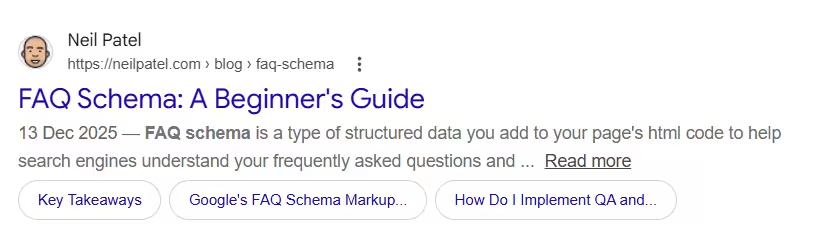
The click-through rate boost comes from expanded real estate in search results. A standard listing gets maybe 2-3 lines. An FAQ-enhanced listing can take up 5-6 lines, pushing competitors further down the page. SEO audits almost always reveal missed FAQ schema opportunities.
Which Questions Actually Win Featured Snippets?
Not all questions are equal. Through analyzing hundreds of travel-related snippet wins, I have identified patterns that predict success.
Questions That Work
Questions starting with “What,” “How much,” “Do I need,” and “Is it safe” perform exceptionally well for travel content. These are informational queries where Google wants to give a direct answer.
Specific examples from my client work:
- “What documents do I need to enter [country]?”
- “How much does it cost to visit [destination]?”
- “Is [destination] safe for solo travelers?”
- “Do I need travel insurance for [country]?”
- “What is the best month to visit [destination]?”
- “How many days do you need in [city]?”
These questions share common traits: they have clear, factual answers, they address pre-booking concerns, and they match how real travelers search.
Questions That Fail
Avoid questions that are too broad, too subjective, or that Google prefers to answer with other content types. “What are the best hotels in Barcelona?” will lose to list-based articles every time. “Why should I visit Thailand?” is too vague for a snippet answer.
Questions that require visual answers also underperform. “What does the Colosseum look like?” will trigger image results, not FAQ snippets. Focus on questions where text answers make sense.
Finding the Right Questions
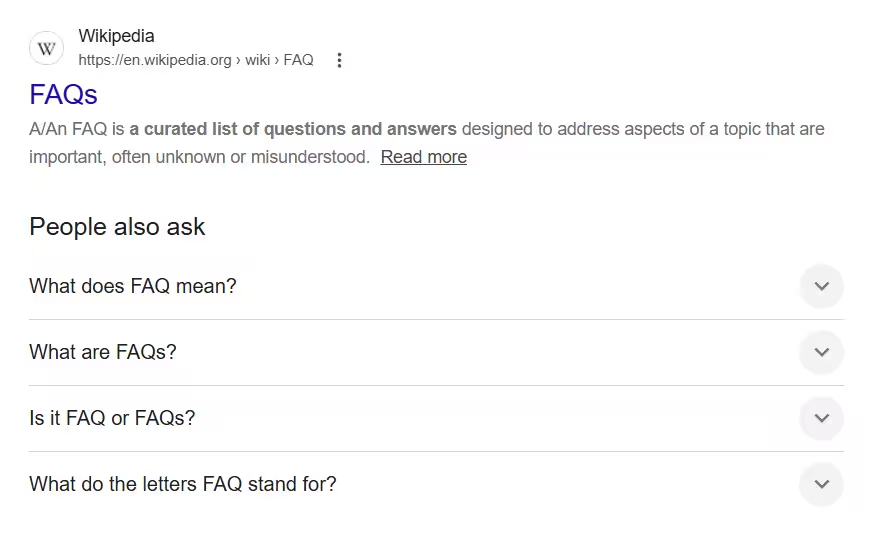
Use the “People Also Ask” section in Google as your primary research tool. Search for your target destination or travel topic, then document every PAA question that appears. These are literally the questions Google has already identified as relevant.
Combine this with tools like AlsoAsked.com or AnswerThePublic to build a comprehensive question database. I typically compile 50-100 questions for each major destination page, then select the 5-8 strongest candidates for FAQ schema implementation.
Look at search volume data in Ahrefs or Semrush, but do not obsess over it. Many FAQ queries show low volume but drive highly qualified traffic. A question with 50 monthly searches that leads to a $3,000 tour booking is worth more than a 5,000-search query that attracts window shoppers.
How to Implement FAQ Schema Correctly
Implementation sounds simple but I see it done wrong constantly. Here is the exact process I use.
JSON-LD Structure
Always use JSON-LD format, not microdata. JSON-LD is cleaner, easier to maintain, and preferred by Google. Place the script in the head section or just before the closing body tag.
Here is a template for a travel FAQ:
<script type="application/ld+json">
{
  "@context": "https://schema.org",
  "@type": "FAQPage",
  "mainEntity": [{
    "@type": "Question",
    "name": "Do I need a visa to visit Costa Rica?",
    "acceptedAnswer": {
      "@type": "Answer",
      "text": "Citizens of the US, Canada, UK, and most EU countries do not need a visa for stays up to 90 days. You will need a passport valid for at least 6 months and proof of onward travel."
    }
  },{
    "@type": "Question",
    "name": "What is the best time to dive in Costa Rica?",
    "acceptedAnswer": {
      "@type": "Answer",
      "text": "December through April offers the best visibility, averaging 60-100 feet. The dry season means calmer seas and better conditions for beginners. However, manta rays are more common during the rainy season from May to November."
    }
  }]
}
</script>
Critical rules: The question text in your schema must match the question text visible on your page exactly. The answer in schema must be a subset of what appears on the page. Google checks this and will not display FAQs where the markup does not match visible content.
WordPress Implementation
If you use WordPress with Yoast SEO Premium or Rank Math Pro, you can add FAQ blocks directly in the editor and the plugin generates schema automatically. This is the easiest method for content teams.
For more control, I prefer manual JSON-LD added through a plugin like Insert Headers and Footers or directly in the theme template. This lets me optimize the schema independent of how the FAQ displays visually.

Validation
Always validate your implementation before publishing. Use Google’s Rich Results Test at search.google.com/test/rich-results. Paste your URL and confirm the FAQ schema appears without errors.
Common errors I catch in audits:
- HTML tags in the answer text causing parsing errors
- Mismatched quotation marks breaking JSON structure
- Answers that exceed 300 words (Google may truncate)
- Questions not visible on the actual page
Formatting Tips That Separate Winners
The difference between FAQ schema that wins snippets and FAQ schema that gets ignored often comes down to formatting details.
Answer Length Sweet Spot
Keep answers between 40-60 words for best snippet potential. Too short and Google may see it as incomplete. Too long and it gets truncated awkwardly. I aim for 2-3 sentences that deliver a complete, useful answer.
Compare these two answers to “What is the best time to visit Thailand?”
Weak: “November to February.”
Strong: “November to February is ideal, with cool, dry weather across most regions. This is peak season, so book accommodations early. March and April are hot but cheaper, while June through October brings monsoon rains to the west coast.”
The strong answer is specific, acknowledges tradeoffs, and gives actionable context. Google rewards completeness.
Front-Load the Answer
Put the direct answer in the first sentence. Google often displays only the first 1-2 sentences in snippets, so burying the answer in sentence three means it might never be seen.
Include Specifics
Numbers, dates, prices, and names make answers more credible and useful. “Entry costs around $20” beats “Entry has a fee.” Specific answers also reduce follow-up searches, which Google interprets as satisfying user intent.
Update Regularly
Travel information changes constantly. Visa requirements, prices, seasonal recommendations all shift over time. I set quarterly reminders to review FAQ content on high-traffic pages. Outdated answers hurt both rankings and user trust.
Tourism-Specific FAQ Strategies
Different travel website types need different FAQ approaches.
Destination Marketing Organizations
DMOs should focus on practical visitor questions: transportation, best seasons, safety, accessibility, events. Avoid promotional questions like “Why visit our destination?” because these do not match real search behavior.
I worked with a state tourism board where we implemented FAQ schema on their top 20 destination pages, targeting questions from their own call center data. Call volume decreased 15% because visitors found answers online. That is the sign of effective FAQ content.

Hotels and Resorts
Property-level FAQs should address booking concerns: cancellation policies, check-in times, parking, pet policies, nearby attractions. These questions often appear in the booking consideration phase, making them high-value targets.
Tour Operators
Focus on experience-specific questions. For CostaRicaDivers.com, questions like “How deep do you go on beginner dives?” and “What if I panic underwater?” addressed real fears that blocked bookings. FAQ schema put these reassuring answers directly in search results.
Tourism SEO strategy should integrate FAQ planning from the start, not treat it as an afterthought.
Travel Agencies and OTAs
Comparison and policy questions work well: “What is the difference between these tour options?” or “What happens if my flight is cancelled?” These build trust by demonstrating expertise and transparency.
Measuring FAQ Schema Performance
Implementing schema without measurement is pointless. Here is how I track results.
In Google Search Console, check the Performance report and filter by URL to see if impressions and clicks increase after implementation. Look at the Search Appearance filter to see how often your pages appear with FAQ rich results.
Track specific queries in position monitoring tools. If you target “Do I need a visa for [destination]” with FAQ schema, monitor that exact query weekly. Snippet wins can happen within 2-4 weeks of implementation.
Click-through rate is the most important metric. Compare CTR before and after FAQ implementation for the same queries. I typically see 15-30% CTR improvements on pages where FAQs render properly.
Common Mistakes to Avoid
After reviewing hundreds of travel website implementations, these errors appear constantly:
- Too many FAQs on one page. Google recommends keeping FAQ schema to questions genuinely covered on the page. Adding 20 FAQs just to maximize schema often backfires. Stick to 5-8 high-quality questions.
- Generic questions. “What is tourism?” or “Why do people travel?” waste schema on queries nobody searches. Be specific to your destination, property, or experience.
- Duplicate FAQ schema across pages. If the same FAQ appears on multiple pages with identical answers, Google may ignore it. Each page’s FAQs should be unique to that page’s topic.
- Ignoring mobile formatting. FAQ rich results display differently on mobile. Test how your expanded answers look on phone screens. Long answers may hurt readability.
Frequently Asked Questions
Does FAQ schema guarantee featured snippets?
No. FAQ schema makes you eligible for FAQ rich results, but Google decides whether to display them based on relevance, competition, and answer quality. I have seen well-implemented FAQ schema get ignored because competitors had better content or higher domain authority. Schema is necessary but not sufficient.
How many FAQs should I add per page?
Five to eight is the sweet spot for most travel pages. Fewer than five often seems thin. More than ten dilutes focus and can look spammy. The exception is comprehensive destination guides where 10-12 FAQs addressing distinct topics can work well.
Can I use FAQ schema for promotional content?
Technically yes, but it rarely wins snippets. Questions like “Why book with us?” or “What makes our tours special?” do not match real search queries. Google prioritizes informational questions with objective answers. Save promotional messaging for other page elements.
How long before FAQ schema affects rankings?
I typically see rich results appear within 2-4 weeks of implementation, assuming no validation errors. Ranking improvements from increased CTR take longer, usually 4-8 weeks. Some competitive queries may never show FAQ results regardless of your implementation quality.
Should FAQ answers link to other pages?
You can include internal links in FAQ answers, and they pass value like any other link. However, keep answers focused on answering the question. Do not stuff links into every answer. One relevant link in a longer answer is fine. Multiple links per answer looks manipulative.
Do FAQ rich results affect voice search?
Yes. Google Assistant and other voice assistants often pull answers from FAQ schema when responding to spoken queries. Short, conversational answers perform best for voice. This is why the 40-60 word answer length works well: it is speakable.
Need help with your FAQ?
If you want me to audit your travel website’s FAQ schema implementation or identify snippet opportunities you are missing, get in touch. I offer both one-time audits and ongoing optimization for DMOs, hotels, and tour operators.

About the Author
I’m Peter Sawicki, a Destination SEO Strategist helping tourism brands and DMOs grow their online presence through SEO, technical audits, and creative digital strategies. Over the years I’ve worked across multiple countries and markets, which gives me a global perspective on every project I take on. When I’m not optimizing websites, you’ll most likely find me underwater. Scuba diving is where my two biggest passions meet.